


In the context of a global transition toward a green economy, Hydrogen (H₂) has emerged as a critical link in carbon emission reduction strategies. In Vietnam, one of the leading automotive manufacturers has embarked on the journey toward a clean energy future through the 6,000-liter Hydrogen Charging, Discharging, Storage & Transportation System (Hydrogen Compact Storage) project.
As pressure vessel design engineers directly responsible for the calculation and design of Hydrogen Compact Storage tanks compliant with PED 2014/68/EU and EN 13445, we recognize that this is not merely a conventional mechanical project, but a transformation in materials engineering and pressure safety under extreme operating conditions.
1. Operating Principle: The Core of Next-Generation Energy Storage Technology
Unlike conventional Hydrogen storage methods such as liquefied hydrogen (LH₂) at cryogenic temperatures or high-pressure compressed gas (up to 700 bar), this Hydrogen storage system applies an advanced chemical storage principle based on the redox cycle of iron (Fe) and iron oxides (Fe₃O₄).
Unique Charging and Discharging Cycle:
The system operates based on two primary phases, where Hydrogen is stored and released through high-temperature chemical reactions:
Charging Cycle (Loading):
Hydrogen gas reacts with iron oxide (Fe₃O₄) to produce metallic iron (Fe) and water vapor. This is a strongly endothermic reaction, requiring the reactor chamber to maintain temperatures up to 850°C to ensure optimal reaction efficiency.
Discharging Cycle (Unloading/Discharge):
When Hydrogen release is required, superheated steam (H₂O) is introduced to oxidize the iron, regenerating Hydrogen gas (H₂) and Fe₃O₄. The operating temperature in this phase remains extremely high, ranging from 650°C to 850°C.
2. Material Challenges and Creep Resistance at 850°C
At temperatures of 850°C, most conventional carbon steels or low-alloy steels experience significant loss of mechanical strength and are susceptible to creep deformation – time-dependent permanent deformation under sustained stress.
Creep Assessment (Creep Analysis)
According to EN 13445, the design of pressure vessels operating in the creep regime requires far more stringent calculations compared to ambient temperature conditions. Specialized high-temperature alloy steels with excellent heat resistance and hydrogen resistance (such as high-strength Chromium-Molybdenum steels) must be selected.
Creep evaluation includes:
- Material life assessment: Based on long-term creep rupture strength for a minimum service life of 50,000 operating hours.
- Deformation control: Ensuring that vessel components do not undergo excessive thermal expansion that could damage weld joints or precision components such as expansion joints (compensators).
- Hydrogen effects: At elevated temperatures, Hydrogen tends to diffuse into the steel microstructure, leading to hydrogen embrittlement. This is the reason for adopting an innovative double-jacket design.
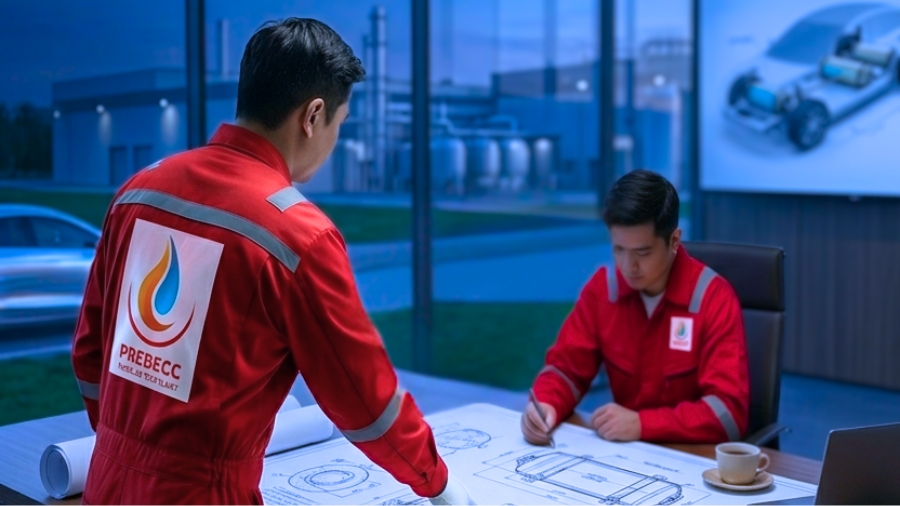
3. Fatigue Challenges due to Pressure and Temperature Cycling
This Hydrogen compact storage system does not operate under static conditions. The vessel may undergo 1–2 loading/unloading cycles per day, resulting in thousands of cycles over its service life.
A typical fatigue cycle includes:
- Pressure increase: Internal pressure can reach up to 11 bar.
- Temperature variation: From ambient temperature up to 850°C and back.
The mismatch in thermal expansion between the internal reaction chamber and the external pressure shell generates extremely high thermal stresses. To address this, Finite Element Analysis (FEA) is utilized to accurately simulate stress concentration at critical locations such as nozzles, support structures, and weld joints.
Fatigue life assessment must consider not only pressure cycles but also thermal fatigue, which is a critical factor for high-temperature pressure vessels.
4. Technological Breakthrough and Vision for Sustainable Green Energy
The successful design of the 6,000-liter Hydrogen charging, discharging, storage, and transportation system represents not only a milestone in precision mechanical engineering but also a solution for large-scale energy storage in Vietnam.
Achieving stable operation at 850°C, effectively controlling creep behavior, and ensuring fatigue resistance under stringent pressure conditions to meet PED/CE certification demonstrates strong domestic capabilities in mastering advanced global technologies.
This project also highlights PREBECC’s capability in developing energy systems that are not only high-performance but also safe for human operation and environmentally sustainable.